Table of Contents
Key Summary
Learn how AI-powered virtual CFO services are transforming financial management in 2026 through predictive analytics, real-time forecasting, cash flow monitoring, scenario planning, and proactive business decision-making.
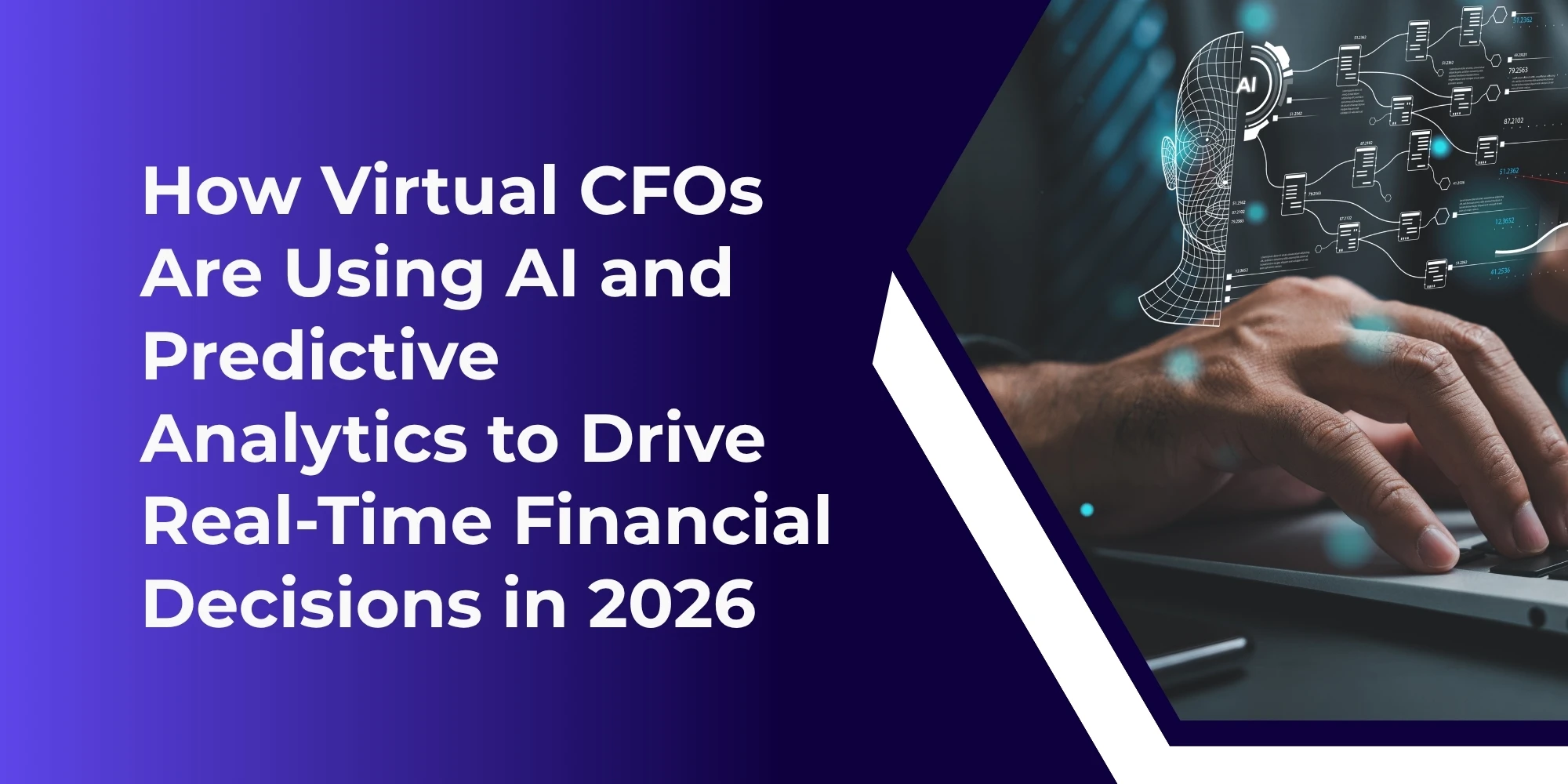
The role of the Virtual CFO has undergone a fundamental shift in 2026. What was once a position focused on periodic reporting, budget reviews, and backward-looking analysis has become a real-time strategic function, driven by AI tools and predictive analytics that process financial data continuously rather than monthly. For small and mid-sized businesses that cannot justify the cost of a full-time CFO, virtual CFO services powered by AI now deliver a quality of financial insight that was previously available only to large enterprises with dedicated finance departments.
Key Takeaways
- Can AI improve financial forecasting accuracy? Yes, significantly. AI-driven forecasting tools such as DataRails, Mosaic, and Cube analyze thousands of variables simultaneously, including invoice-level payment behavior, market signals, and operational data, producing forward-looking predictions that are materially more accurate than traditional spreadsheet-based models.
- How are virtual CFOs using AI in 2026? By integrating AI tools into cash flow forecasting, scenario modeling, anomaly detection, accounts receivable risk scoring, and real-time dashboard reporting, virtual CFOs now provide continuous financial oversight rather than point-in-time analysis.
- Is predictive analytics useful for small businesses? As of March 2026, AI-powered Virtual CFO products specifically designed for small businesses are entering the market, offering proactive cash flow risk detection, supplier payment optimization, and scenario modeling through existing accounting platforms.
- What is the biggest shift AI creates for CFO work? The transition from retrospective reporting to real-time decision-making, from reading a dashboard to having a dialogue with your financial data.
- What is the risk of not adopting AI in financial planning? According to DFIN's 2026 CFO Guide, 83% of CFOs now use AI for data analysis and 55% for risk management. Businesses that have not made this transition face a structural disadvantage in planning speed, forecast accuracy, and risk visibility.
The traditional financial reporting cycle- close the books, produce the monthly report, schedule the review meeting, identify the problem that occurred three weeks ago- has a fundamental flaw: by the time the insight arrives, the opportunity to act on it has passed. For small businesses operating with tight margins and limited capital, late visibility into cash flow problems, customer payment risks, or cost overruns is a genuine business threat.
Virtual CFO services have historically addressed this by providing part-time senior financial expertise to businesses that cannot sustain a full-time CFO salary. But in 2026, the virtual CFO model has been transformed by AI and predictive analytics into something categorically more powerful. The modern virtual CFO is not just a financial expert reviewing reports; they are a strategic partner operating with AI tools that model multiple futures simultaneously and surface decisions that need to be made before the underlying problem becomes visible in the numbers.
What Predictive Analytics Actually Does for Financial Planning
Predictive analytics in finance uses statistical models and machine learning to forecast future outcomes, revenue, cash flow, cost trajectories, and risk exposure, based on historical data, current operational data, and external market signals. The output is not a static projection but a continuously updated set of forward-looking signals that finance leaders can act on immediately.
For a virtual CFO serving multiple small business clients, AI-powered predictive analytics enables:
- Invoice-level cash flow forecasting: Tools like Fathom and Pulse analyze individual invoice payment histories, customer risk profiles, and dispute patterns to predict exactly when specific receivables will be settled, three weeks before a shortfall appears in the bank account.
- Scenario modeling on demand: FP&A platforms such as DataRails, Vena, and Cube allow virtual CFOs to run "what if" simulations in real time. What happens if a major client delays payment by 30 days, or revenue drops 10%? These questions are answered in minutes, not days.
- Anomaly detection and early warning: Machine learning models built into platforms like Finsider automatically flag deviations, an unusual vendor invoice spike, a gradual shift in customer payment timing, a cost category creeping above baseline, in real time rather than in the next monthly review.
The Shift from Reporting to Real-Time Decision-Making
The defining characteristic of AI-driven virtual CFO work in 2026 is the transition from retrospective to prospective. Scott Grossman, CFO of Ensono, summarized it directly: "Innovations in generative AI and predictive analytics will empower finance teams to progress from mere automation to real-time insights and scenario modeling. AI will enable CFOs to foresee risks, optimize capital allocation, and enhance decision-making with unmatched speed and precision."
For small businesses working with a virtual CFO, this means financial guidance that is proactive rather than reactive. Instead of a monthly meeting to review what happened, business owners receive continuous signals about what is about to happen and what decisions are available right now. According to CFO.io's February 2026 analysis, the question for finance leaders is no longer whether to adopt AI but whether their current systems can support the real-time strategic work that AI enables. Virtual CFOs who have integrated tools like Anaplan, Pigment, or Mosaic into their practice are already operating at this level on behalf of their clients.
How Virtual CFOs Are Using AI Across Industries
AI adoption in virtual CFO work is not uniform; the tools and applications vary meaningfully by industry, reflecting different cash flow patterns, compliance environments, and data structures.
Retail and e-commerce: Virtual CFOs serving retail businesses use AI forecasting tools to correlate inventory purchasing cycles with revenue projections, flagging overstock risks and optimizing reorder timing against projected cash position. Platforms with native e-commerce integrations enable seasonal demand modeling well ahead of demand peaks, giving businesses time to prepare capital positions.
Professional services and consulting: For project-based businesses, AI models embedded in FP&A tools like Cube and DataRails track billable utilization, invoice-to-collection lag by client, and pipeline conversion rates to forecast revenue with granularity that spreadsheets cannot achieve. Virtual CFOs use these signals to advise on hiring timing and pricing strategy in near real time.
Healthcare and medical practices: AI financial tools help virtual CFOs in healthcare track insurance reimbursement timelines by payer, flag claim denial patterns early, and model the cash flow impact of payer mix shifts, a critical function where reimbursement delays directly affect operational liquidity. Anomaly detection tools are particularly valuable for surfacing billing inconsistencies before they compound.
Manufacturing and distribution: Predictive analytics applied to accounts payable and supplier payment cycles enables virtual CFOs to model working capital requirements dynamically, optimizing payment timing to protect liquidity while preserving supplier relationships. Tools like Vic.ai automate invoice processing on the payables side, reducing manual processing time while maintaining audit-ready records.
Across all industries, the core AI capability, continuous monitoring, pattern recognition, and scenario simulation, remains consistent. What changes are being analyzed, and what specific decisions are being supported?
Security and Data Privacy in AI Financial Tools
For business owners being asked to connect their accounting software to AI-powered financial platforms, data security and privacy are legitimate and important concerns. AI financial tools require access to sensitive business data, bank transactions, payroll records, customer invoices, and vendor payment history, and the standards governing how that data is handled vary across platforms.
When evaluating any AI financial tool or virtual CFO technology stack, business owners should verify:
- Data encryption standards: Financial data should be encrypted both in transit and at rest using current industry-standard protocols (AES-256 or equivalent).
- Access controls and permissions: AI platforms should operate on a least-privilege access model, accessing only the data required for their specific function.
- Third-party data sharing policies: Many AI financial platforms aggregate anonymized data across clients to improve their models. Business owners should understand exactly what data is shared, with whom, and whether it can be opted out of.
- Regulatory compliance: For businesses in regulated industries- healthcare, financial services, legal- any AI financial tool must be evaluated against applicable data protection requirements, including HIPAA, SOC 2, and relevant state privacy laws. Platforms like StackAI are built with enterprise security certifications, including SOC 2, HIPAA, and GDPR compliance by design.
- Vendor security certifications: Reputable AI financial platforms maintain SOC 2 Type II certifications and undergo regular independent security audits. These should be verifiable before integration.
A qualified virtual CFO plays an important role in this evaluation, ensuring that the technology deployed on behalf of a business meets appropriate security standards and that the business owner fully understands what data is being shared and how it is protected.
Where Human Virtual CFO Judgment Remains Essential
AI handles pattern recognition, scenario simulation, and real-time data processing at a scale no human can match. What it does not replace is the strategic judgment, client relationship, and contextual interpretation that experienced virtual CFOs provide.
A model can flag that a client's cash runway is at risk in 47 days based on current receivables velocity. It takes a virtual CFO to determine whether that risk is addressable through accelerated collections, a short-term credit facility, renegotiated supplier terms, or a pricing conversation with a key customer, and to have that conversation in a way that produces action.
The most effective virtual CFO model in 2026 is one where AI handles continuous monitoring and scenario computation, and the virtual CFO handles interpretation, communication, and decision facilitation. As DFIN's 2026 CFO Guide notes, AI adoption success still depends on talent readiness, data quality, and governance. The virtual CFO's role includes ensuring AI tools are working with clean, complete data and that outputs are being acted upon correctly.
How NSKT Global Can Help
For small and mid-sized businesses looking to benefit from AI-powered financial oversight without the cost of a full-time CFO, NSKT Global provides virtual CFO services that integrate the latest AI and predictive analytics tools with experienced strategic financial leadership.
Our virtual CFO services include:
- Real-time cash flow monitoring and AI-powered accounts receivable risk scoring to prevent cash flow surprises before they occur
- Predictive financial forecasting using machine learning models built on your business's actual operational data, not generic industry benchmarks
- Rolling scenario modeling using FP&A platforms for capital allocation, hiring decisions, pricing changes, and growth investments
- Live financial dashboard setup and integration with your existing accounting platform for continuous visibility into key financial metrics
- Accounts payable optimization, including early payment discount analysis and cash-conscious payment scheduling
- Anomaly detection and early warning systems that surface financial risks and opportunities between review cycles
- AI tool security and data privacy evaluation as part of any technology implementation
- Strategic financial planning support for fundraising, banking relationships, and investor reporting
Whether you are a growing startup, an established small business navigating uncertainty, or a scaling company that needs CFO-level discipline without a full-time hire, NSKT Global brings the combination of AI-powered tools and experienced financial judgment that drives better decisions in real time.
FAQs
What is the difference between a virtual CFO and a bookkeeper?
A bookkeeper records transactions that have already occurred. A virtual CFO uses that data, plus AI-powered analytics tools and strategic expertise, to interpret what the numbers mean, forecast what is going to happen, and advise on what decisions to make.
How accurate is AI-powered financial forecasting?
AI forecasting consistently outperforms traditional spreadsheet-based models on accuracy metrics like Mean Absolute Percentage Error (MAPE). The key advantage is adaptability: tools like DataRails and Mosaic update continuously as new data arrives, while traditional forecasts remain static until manually revised.
What accounting software platforms do virtual CFOs typically use with AI tools?
In 2026, the most commonly integrated platforms include QuickBooks Online, Xero, Sage Intacct, NetSuite, and Zoho Books. AI forecasting and FP&A layers such as Fathom, Cube, and Coefficient connect to these via native integrations or open APIs to deliver predictive analytics on top of existing accounting data.
Is a virtual CFO cost-effective for a business with under $2 million in revenue?
Yes. Virtual CFO services are typically priced on a fractional or retainer basis. For businesses in the $500K to $5M revenue range, the ROI, particularly when AI tools improve cash flow management and prevent financial surprises, typically exceeds the cost by a meaningful margin.
How do I know if my financial data is safe with AI tools?
Look for platforms with SOC 2 Type II certification, clear data sharing policies, encryption in transit and at rest, and least-privilege access controls. A qualified virtual CFO should evaluate and confirm these standards before any AI tool is integrated into your accounting environment.